William Rose
Needful ThingsWilliam Rose is the energetic, widely admired Baptist minister whose campaign against Casino Nite becomes one of the most visible expressions of Castle Rock’s Catholic–Baptist hostility. A committed bigot who presents sectarian contempt as religious conviction, he helps turn a dispute over a church fundraiser into a town-wide conflict. In the final violence, however, he and his longtime Catholic adversary Father John Brigham end up supporting one another as the town’s larger catastrophe interrupts their fight.
Identity and Ministry
Rose had led the Baptist congregation since May 1983. His first sermon, titled “Why the Catholics are Hellbound,” established a ministry that repeatedly cast Catholics as misguided and blasphemous. The novel describes him as a bigot, but also as energetic and sometimes witty in a cruel way; his message was popular with his congregation, giving his prejudice a substantial public audience.
His antagonism toward Father John Brigham was mutual and longstanding. Brigham had given Rose the mocking nickname “Steamboat Willie,” which Rose knew about, and the two ministers had clashed before the Casino Nite controversy. Their rivalry gives the dispute a personal history, but Rose’s influence ensures it does not remain merely a quarrel between two clergy members.
The Casino Nite Dispute
The Daughters of Isabella’s plan to hold Casino Nite at the Knights of Columbus Hall renewed the religious antagonism. Rose regarded the event as gambling and an affront to decency. He paid for the “DICE-AND-THE-DEVIL” flyers himself, and Wanda Hemphill and members of her sewing circle posted them around town. The controversy spread into the weekly newspaper’s Letters column, where Catholics and Baptists exchanged accusations and warnings of damnation.
Rose also tried to enlist the town’s law enforcement in stopping the event. When he approached Alan Pangborn, he brought the Maine gambling code and read aloud its prohibition on games of chance involving wagers. Pangborn explained that the organizers collected donations, distributed an equivalent amount of play money, and auctioned prizes rather than paying out money. Rose remained unconvinced: he insisted that the event was gambling and said he intended to stop it with or without Pangborn’s help. The exchange shows both his determination and the gap between his moral argument and the event’s legal arrangement.
Rose’s standing made the dispute politically consequential. After meeting with Danforth Keeton, Pangborn told Polly Chalmers that Rose was more dangerous to his electoral prospects than Keeton: if Pangborn failed to exercise discretion, Rose could help turn the voters against him. Rose’s presence in Pangborn’s office therefore registers more than a complaint; it signals that a religious controversy could become a test of the sheriff’s public authority.
Escalation and Gaunt’s Influence
The hostility deepened over time, with anger running beneath periods of relative calm. By the time Rose received the crudely insulting “Babtist Rat-Fuck” card, the narrative presents a confrontation as increasingly difficult to avoid. The insult did not create the underlying division, but it intensified an already combustible conflict around Casino Nite.
Leland Gaunt’s customers were drawn into pranks directed at Rose and other local targets. Lucille, after buying black pearls at Needful Things, promised Gaunt a prank against Rose, whom she resented for never tipping her. Sonny Jackett later bought a set from Gaunt for $170 and agreed to tricks aimed at Rose and Don Hemphill. These episodes place Rose among the people targeted as Gaunt converts personal resentments into acts that feed the town’s divisions. The evidence identifies him as a target of the pranks, not as their instigator.
As the atmosphere worsened, Father Brigham called a meeting about what he described as religious repression in Castle Rock. The turnout was large enough that the gathering had to move from the rectory to the Knights of Columbus Hall. More than seventy people attended the fourth meeting of the group. Rose’s campaign thus unfolds amid organized public mobilization on both sides, not just isolated exchanges between congregations.
Riot and Aftermath
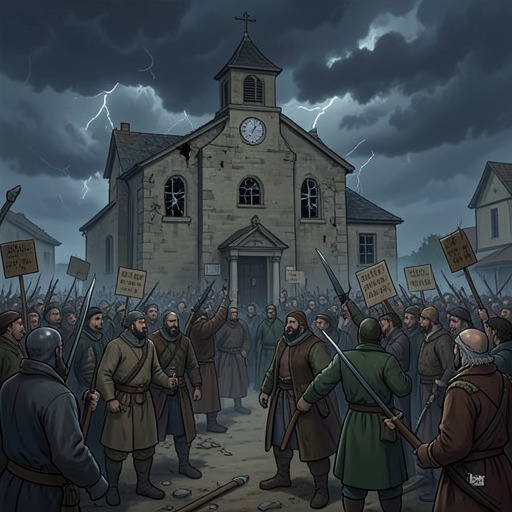
The conflict eventually became physical. Rose joined the Baptist Anti-Gambling Christian Soldiers as they advanced from the Baptist church in heavy rain, with Don Hemphill and others at the front. During the ensuing religious riot, Rose’s upper plate was gone, and he sang along with the group as it moved through the fighting. The scene presents him as an active participant in a collective confrontation, even as the larger breakdown makes the original argument over Casino Nite seem increasingly remote.
A much greater crisis abruptly interrupted the battle. When a fireball appeared on the horizon, Rose sat up and began to suspect that the end of the world had arrived, interpreting what he saw as Star Wormwood. Father Brigham approached him in a drunken, unsteady state. Despite their longstanding antagonism and the violence around them, Brigham helped Rose to his feet rather than striking him. Later, as the religious combatants dispersed, Brigham appeared to be supporting Rose. Their final exchange of actions does not erase their history, but it contrasts sharply with the sectarian hostility they had helped sustain.
Narrative Role
Rose’s arc connects private conviction, institutional influence, and mass conflict. He frames Casino Nite as a moral emergency, uses his pulpit’s authority to oppose it, and carries that opposition into public and political life. The novel also places his prejudices within a town vulnerable to manipulation: Gaunt’s customers turn grievances into pranks, and the existing religious divide supplies a ready channel for escalation. Rose is not shown as the architect of Gaunt’s larger scheme, but his popularity and certainty help make the conflict consequential.
The closing image of Rose and Brigham on the same side of a moment of mutual assistance supplies a restrained counterpoint to their rivalry. Their hostility has contributed to a climate in which neighbors meet as religious opponents; the final crisis briefly reduces that division to two battered ministers, one helping the other stand. The gesture is not presented as a full reconciliation, but it shows how quickly the town’s sectarian contest is overtaken by the destruction surrounding it.